
Our eyes are constantly bombarded by data in our fast-paced world. We jump from the sharp text of work emails to the aggressive, high-contrast imagery of social media feeds. Consequently, our visual processing centers rarely get a moment to rest. Our brains are hardwired to decode symbols, track patterns, and anticipate threats. Therefore, almost everything we look at forces our minds to work actively.
This constant sensory overload is precisely why I create art. I view the canvas as an open invitation to build a visual sanctuary. It is a dedicated space where you can put down the heavy burden of interpretation. By stripping away literal objects, portraits, and landscapes, abstract art interacts directly with your nervous system. As a result, it offers a gentle emotional reset.
But what exactly gives an abstract painting its calming power? How do we use color, fluid movement, and energy to heal the anxious modern mind? Let’s dive deeper into the elements that create visual peace.
What is a Calming Abstract Painting?
To understand calming abstraction, we must first look at what it leaves out. For example, it avoids jagged, fragmented paint splatters. It completely steers clear of chaotic geometric lines and harsh, unyielding color relationships.
Instead, a calming abstract canvas acts as a visual anchor for stillness. It utilizes specific, subdued color palettes, low-contrast gradients, fluid transitions, and balanced organic textures. This combination creates a beautiful sense of expansive space. It is art that does not shout for your attention. Rather, it patiently waits for it.
Historically, this movement links back to Mid-Century Color Field painting and Minimalism. Artists realized that removing recognizable figures allowed the canvas to become a mirror for the viewer’s internal state. When you look at a large, gently blended field of color, you are not looking at an object. Instead, you are experiencing an unmediated mood.
The Neurobiology of “Slow Looking”
The tranquility we feel when looking at a serene piece of art is a measurable psychological response. In modern cognitive science, researchers study a phenomenon known as Slow Looking.
When we look at a highly detailed photograph or a busy street scene, our eyes engage in rapid, jerky movements called saccades. Our brains are actively working to separate foreground from background. We are identifying hazards and decoding data.
However, your visual tracking system calms down when you sit in front of an abstract painting with gentle, shifting tones. The brain stops trying to solve a puzzle because there is no literal puzzle to solve. This mental offloading triggers a quick transition from an active, analytical mindset to a contemplative, meditative state.
Psychologists refer to this process as Attention Restoration Theory (ART). Our minds have a finite amount of “directed attention.” This is the intense, focused energy we use to read, work on laptops, and navigate daily life. Directed attention naturally causes mental fatigue.
To recover, our brains require “soft fascination.” This means an effortless visual experience that holds our attention without demanding cognitive processing. A soft, bleeding gradient or an expansive field of fluid paint is the ultimate vehicle for soft fascination. It quiets the amygdala, which is the brain’s threat-detection center. Consequently, it allows the nervous system to slide safely into a restful, parasympathetic state.
My Journey with Three Distinct Pathways to Calm
I structure my studio practice around creating environments of rest. However, rest looks and feels different to every individual. Here is how my three distinct works—Burst of Color, Expansive Light, and Winter Solstice—demonstrate that tranquility can be found through diverse emotional pathways.
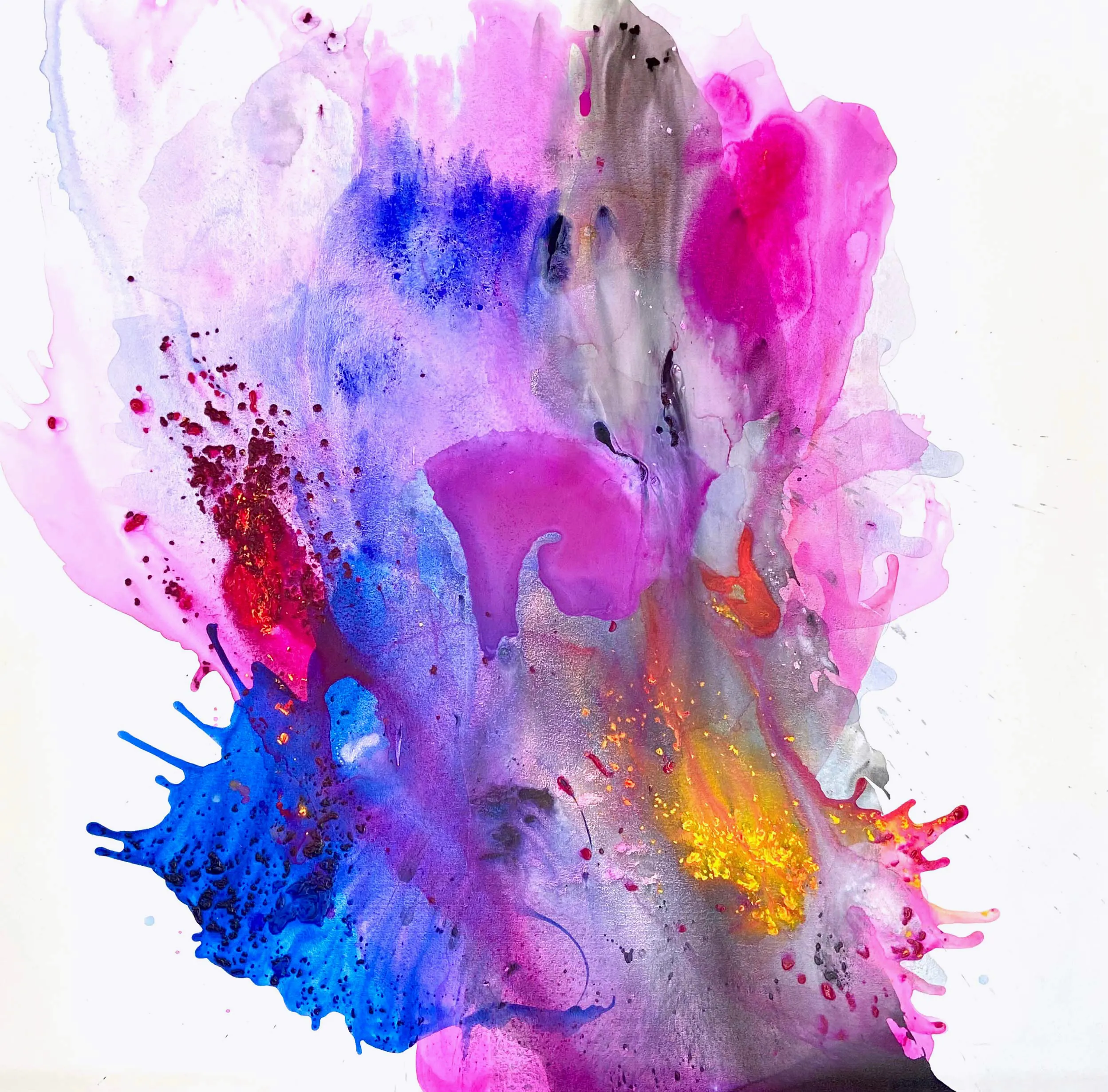
Case Study 1: The Paradox of Catharsis in Burst of Color
When people imagine a calming abstract painting, they often default to thinking of flat, silent canvases painted exclusively in pale shades of oatmeal, taupe, or misty gray. However, I have found a different truth in my studio. True visual peace can also be achieved through vibrant, dynamic energy. Finding calm does not mean suppressing our vibrant emotions. Instead, it means giving them space to flow and settle beautifully. This concept is the driving force behind my work, Burst of Color (60×60).
In Burst of Color, I present a brilliant explosion of deep magenta, rich cobalt blue, and glowing violet. At first glance, the title and the primary hues suggest high intensity. Yet, the overall emotional resonance of the piece remains deeply soothing. How do we achieve tranquility through a “burst”?
The Law of Negative Space. The secret lies in a masterful command of negative space. The intense, bleeding pigments are entirely concentrated into a singular, floating form in the center of the 60×60-inch canvas. It is surrounded by an expanse of clean, breathing white space. This stark juxtaposition means the colors never overwhelm the viewer. The white space acts as a visual shock absorber. Therefore, it gives your eyes a safe place to rest and step back.
Organic Fluidity and Healing. Furthermore, the edges of the paint are soft, bleeding, and organic. They are highly reminiscent of water blooming on paper or the natural flow of thermal springs. I intentionally utilize the pouring and manipulation of liquid paint to create a sense of buoyancy and flow. Because the forms move like natural fluids rather than rigid, manufactured structures, they tap directly into our evolutionary affinity for nature. The painting serves as a visual metaphor for emotional catharsis. It represents an honest, joyful release of internal energy that ultimately settles into a perfect, harmonious equilibrium.
Case Study 2: Movement and Energy in Expansive Light
Rest is not always a state of total stillness. Sometimes, true mental rest comes from an intuitive flow. My piece, Expansive Light (48×80), explores this beautiful intersection of movement, energy, and serenity.
In Expansive Light, the canvas comes alive with a striking contrast. I set a deep, anchoring teal-indigo form against fields of warm, glowing ambers and soft, ethereal yellows. This painting has an undeniable sense of momentum. Crimson micro-splatters dance near the top, creating a vivid pulse of life. Many people ask how a piece with so much movement can remain calming. The answer lies in the harmony of the composition.
The Power of Uplifting Composition The color blocks in Expansive Light are applied in translucent, weightless glazes. This transparency keeps the energy gentle rather than aggressive. Furthermore, the sweeping orientation of the pigments guides the viewer’s eye upward and outward. This creates an immediate psychological sensation of weightlessness and open space.
True serenity does not require absolute silence. Instead, it requires visual balance. By pairing highly energetic warm tones with deeply grounding cool tones, Expansive Light captures the exact rhythm of a sunrise breaking through morning fog. It shows us that energy, when allowed to flow without rigid boundaries, becomes a powerful source of peace.

Case Study 3: The Deep Immersion of Winter Solstice
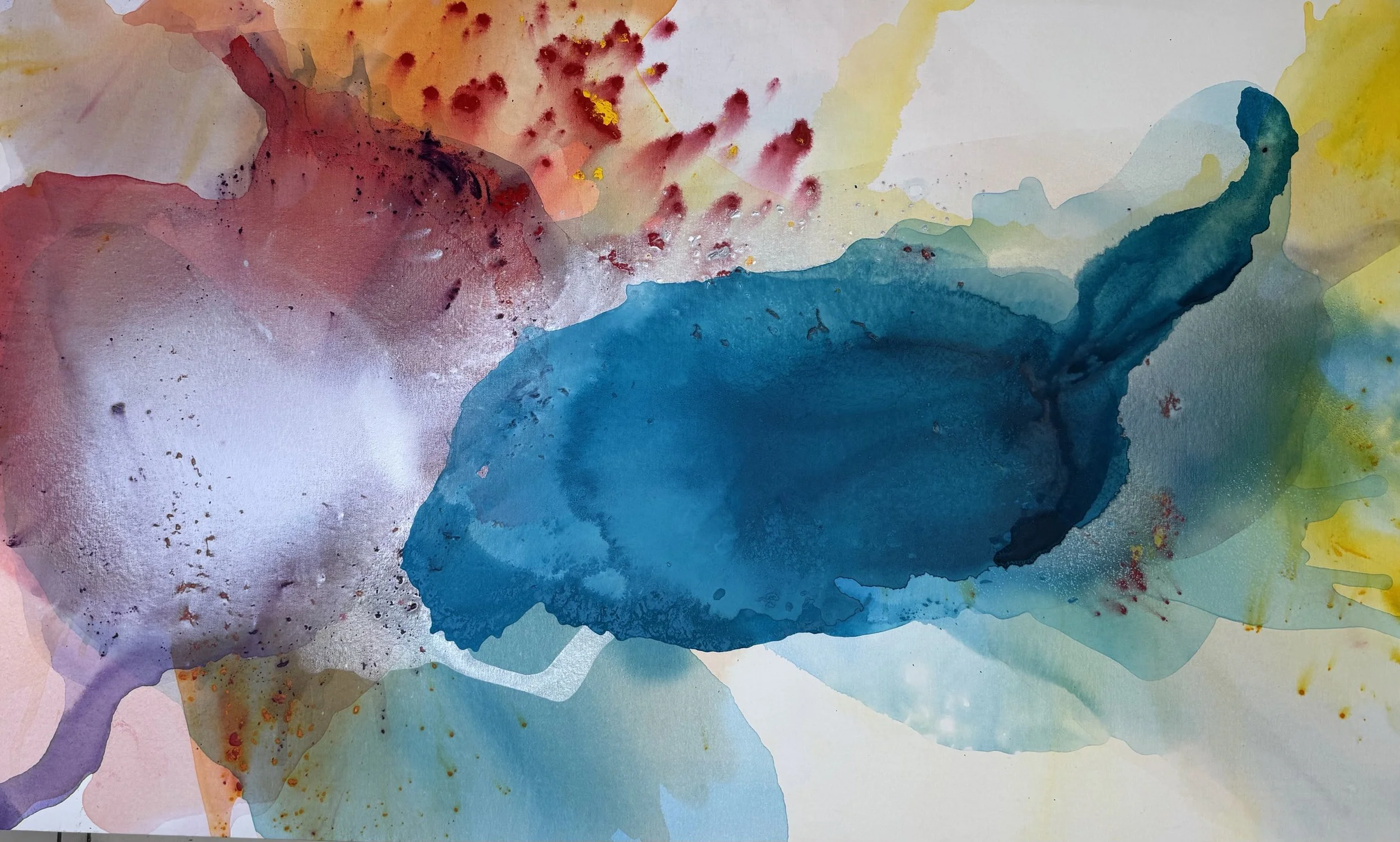
While Burst of Color captures emotional breakthrough and Expansive Light celebrates balanced movement, my panoramic piece, Winter Solstice (48×80), explores absolute stillness. It invites you into the profound, comforting depth of an oceanic landscape.
At a sweeping scale, the layout of Winter Solstice is intentionally designed to wrap around your peripheral vision. When you stand in front of it, the physical noise of the room begins to fade. An immersive environment of rich blues and frosted, textured whites quickly replaces it.
The Psychology of Oceanic Blues Color psychology tells us that deep blues and cobalts are universally grounding colors. They successfully lower the heart rate and clear the mind. In Winter Solstice, I manipulated the pigments to form intricate, lacy textures. These patterns beautifully mirror the organic crystallization of ice and the rhythmic, slow churning of winter waves.
The Weightlessness of Floating Forms. Just like the previous works, the massive blue form in Winter Solstice is beautifully cradled by pristine white space. It never feels trapped or claustrophobic. Instead, the heavy, deep blues appear to float effortlessly across the canvas.
For the viewer, watching something so massive and deeply colored feel completely weightless creates a profound sense of relief. It shows us that our own deep, heavy emotions can float lightly if we give them the right environment to breathe.

My Design Principles: How I Architect Serenity
I do not believe a calming painting happens by accident. It requires deliberate, masterful restraint. When I am working on a new collection in the studio, I focus heavily on three core elements to ensure the final piece serves your home as a sanctuary.
-
Soft Transitions: High-energy art uses sharp, jagged, and fragmented lines. To create peace, I favor “lost-and-found” edges where one color bleeds seamlessly into the next. This approach mimics the soft transitions found in nature.
-
Tactile and Living Textures: Texture plays a massive role in how we perceive emotional weight. Canvases with physical, tactile layers add a reassuring human element. Soft, sweeping brushstrokes and poured layers ground the viewer, reminding us of natural surfaces like weathered rock or sea glass.
-
Intuitive, Asymmetrical Balance: Calming art rarely uses stiff, perfect symmetry. Perfect symmetry can easily feel cold and corporate. Instead, I rely on an intuitive balance. This allows large areas of the canvas to remain completely quiet, open, and untouched by chaotic detail.
The Collector’s Guide: Styling Your Personal Sanctuary
Bringing the healing benefits of abstract art into your own home requires careful thought. You must look at how the artwork interacts with your specific environment.
Scale and Presence
When it comes to creating an emotional escape, scale matters immensely. A tiny frame on a massive wall can look cluttered or lost. This layout forces the eyes to strain to see detail.
To create a true sensory escape, you should opt for a large-scale canvas. A 60×60 or a 48×80 inch statement piece is ideal. When a painting takes up a significant portion of your visual field, it blocks out the visual noise of the room. Consequently, it draws you completely into its quiet atmosphere.
The Lighting Code
The way light interacts with paint completely changes its emotional weight. I always recommend avoiding harsh, direct spotlights because they cause strong glare. Glare quickly strains the eyes.
Instead, look for soft, warm, diffused lighting. Because my work utilizes rich, layered textures, side-lighting from a floor lamp works beautifully. Soft morning sunlight from a window will also cast gentle, shifting shadows across the canvas throughout the day. This keeps the piece feeling alive yet perfectly serene.
Conclusion: A Quiet Place to Rest
Our homes have increasingly become multi-functional spaces where we sleep, stream entertainment, and work. Because the boundaries between our professional and personal lives have blurred, creating a physical boundary for relaxation is essential.
Placing a calming abstract painting in a bedroom, living room, or home office serves as a functional tool for mindfulness. As Pablo Picasso beautifully stated, “Art washes away from the soul the dust of everyday life.”
When placed at the end of a long hallway, over a fireplace, or directly opposite your workspace, a peaceful canvas acts as a visual transition zone.
It marks where daily stress ends, and restoration begins. It asks nothing of you—except to breathe.
Ultimately, abstract art matters because it allows us to feel without needing to explain why. In the quiet lines, intentional white space, and rich washes of color of my work, I hope you find a rare, beautiful commodity: a quiet place for your mind to truly rest.
Bring Serenity Into Your Space
Ready to transform your home into a peaceful retreat? Discover Clara Berta's original works, custom commissions, and large-scale canvases designed to bring an enduring sense of calm to your everyday life.
Explore Collection

