
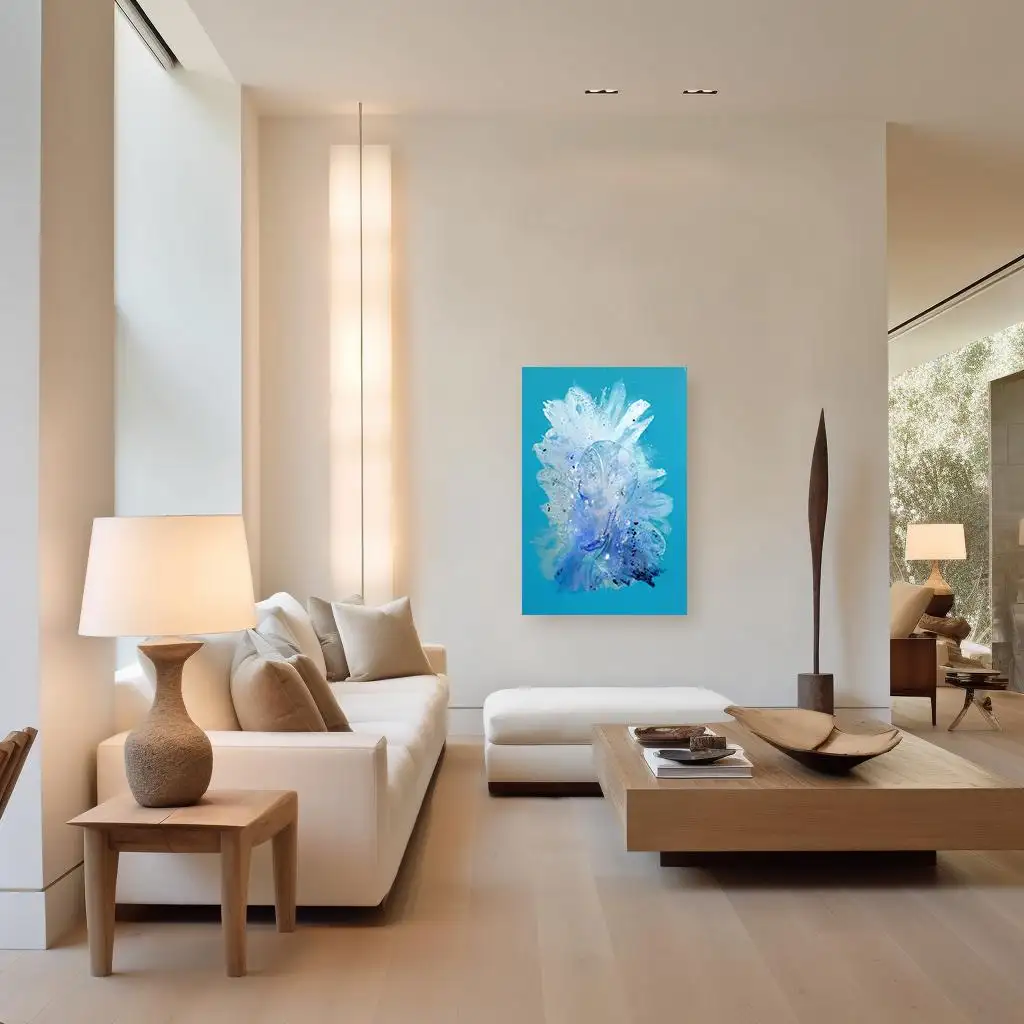
Laguna Bay, Mixed-media on canvas, 60×40
We often think of the artist’s studio as a place of romantic chaos—a whirlwind of splattered paint and frantic energy. But for me, the creative process doesn’t begin with the first mark on a canvas. It begins with something much more grounded and vital. It begins with The Ritual of Clearing.
For me, surroundings are everything. As a contemporary abstract artist in California, I have learned over the years that if my space is not clean and functioning, my mind cannot be either. I am simply not the kind of artist who can thrive in clutter. This stems from a deep-rooted love for a minimalist lifestyle. To me, minimalism isn’t about emptiness; it’s about intentionality. It’s about ensuring that every object in my space, and every thought in my head, has a reason for being there. A cluttered room creates a cluttered frequency, and in the world of one-of-a-kind fine art, clarity is the most important tool I own.
The Great Clearing: The USC Pivot
My path to this minimalist clarity was not a straight line. For fifteen years, I worked as a secretary, managing the order and flow of others’ lives. Eventually, I had enough. My late husband, Dr. Henry Rappaport, a world-renowned pathologist, encouraged me to finish my bachelor’s degree in psychology. I loved that season; it was a time of creative writing and learning about the depths of the human condition.
However, the pressure to keep achieving led me to USC to pursue a master’s in gerontology. It was there that I hit a wall. In the world of statistics and data, I felt like a mere number. I realized I was trying to fit a vibrant, abstract soul into a linear, statistical box. I had what I now recognize as a necessary meltdown.
That meltdown was my first true “Ritual of Clearing.” It was the moment I learned to say no to something that was no longer working for me. I had to let go of the expectations I had for who I thought I should be to find my true voice. Part of that evolution was finding my own identity as a contemporary abstract artist in California. While I loved carrying my late husband’s name, becoming “Clara Berta” was essential to my growth. I needed to stand on my own two feet and sign my work with a name that represented my own discovered truth. My late husband, with immense compassion and support, understood this. He saw the artist in me even when I couldn’t, and his permission to be creative again was the greatest gift I ever received.
The Integrity of the Wall
This innate need for a clear, functioning foundation is why I couldn’t ignore the leaks in my studio when the rain started coming in “big time.” Just as I had to say “No” to a master’s degree that was suffocating my spirit, I had to say “No” to a compromised studio wall.
I didn’t just wipe the surface of those walls. My nature—partly inherited from my mother’s own need for order and partly forged through years of professional discipline—demanded that I go to the root. I cut out the entire section of the wall that was wet, pulling out the “soft stuff”—the damp, heavy insulation that was holding onto the decay.

Hole in the Wall, creative work by female artist.
It was grueling, messy work, but it was a minimalist’s necessity. You cannot have a clean, focused mind if you know there is mold thriving behind the drywall. I brought in a dehumidifier to aggressively pull the moisture from the air, and the difference was immediate. The air shifted from heavy to light. By removing the dampness, I was restoring the purity of my art studio. Once the air was clear, the “heaviness” in my own mind lifted. I had reclaimed my inspiration, I needed to create.
Legacy: The Peter Max Influence
As a collector myself, I understand the weight of an original. I still remember the day I acquired my Peter Max—a gift from my late husband. We met the artist in person and watched him sign the back of the work. That moment was magical; it transformed a piece of art into a lifelong memory.
Today, that piece hangs in my home studio. When the sun reflects through the room at different times of the day, the colors change. They are vibrant, magical, and alive. This painting is a time capsule of my husband’s love and the artist’s spirit. It is the gold standard I hold for my own work. When I paint, I am chasing that same “vibration of the real.” I want to create the “vibrant” work that survives decades, becoming a vessel for someone else’s memories.
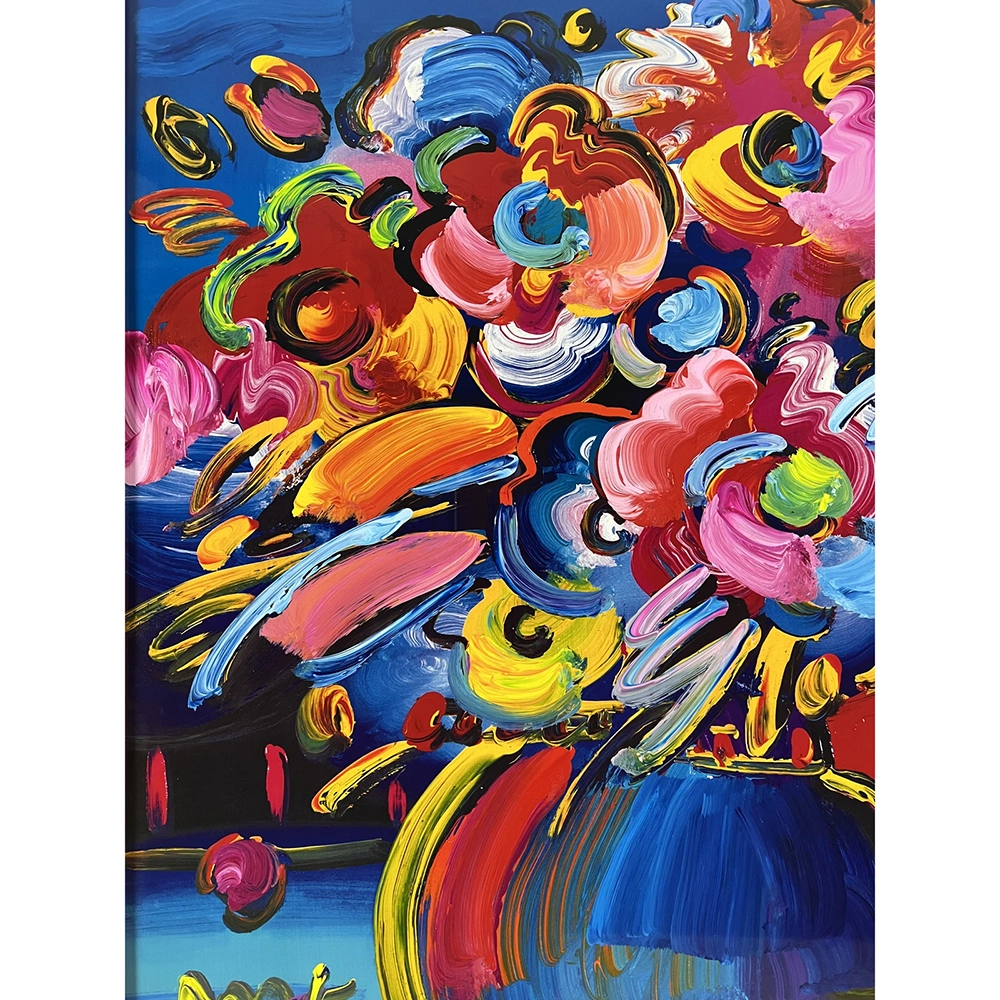
Peter Max’s floral still lifes are alive with bold, fauvist color, motion and kinetic brushwork. A collector favorite, they showcase his spontaneous yet controlled expressionistic painting style which emerged in the early 1960s.
“Kinetic Brushwork“: This is a term often used to describe Max’s spontaneous, high-energy strokes.
“Fauvist Palette“: Refers to the wild, non-traditional colors he uses for the flowers (like electric pinks and yellows against that dark blue).
“Atmospheric Tension“: A great phrase to describe how the bright flowers “pop” against the moody, grounding blue.
The Philosophy of the “Only One”
This commitment to a cleared space and a singular identity is exactly why I choose not to sell prints. To mass-produce an image is to create “stuff” for the sake of “stuff.” It contradicts my minimalist values. A print is a reproduction; it cannot capture the history of the ritual that happened beneath it. It cannot communicate the physical work of repairing a wall or the emotional work of finding one’s own name. That’s why I only offer original abstract art for sale.
My work is about connection. And that connection is strongest when the work is singular. By creating only one-of-a-kind pieces, I am honoring the “cleared” space in which they were made. Each original is a milestone in my artistic evolution—a journey away from being a “number” in a statistics class and into being Clara Berta, the artist.
The Organized Artist: New Standards
There is a persistent myth that abstract art is “accidental.” But the truth is, the most profound abstraction requires a high level of mental and environmental discipline. My need for order is what allows me to trust my process as a contemporary abstract artist in California. Because I know my studio is clean, my walls are dry, and my tools are organized, I am free to take risks on the canvas.
I don’t have to worry about the “background noise” of a failing space or a cluttered mind. The minimalist discipline I’ve practiced my whole life provides the safety net. It allows me to go into the chaos of a painting because I know I have a solid, functioning foundation to return to. My paintings are the result of an organized mind finding the freedom to play in a cleared space.
Conclusion: The Beauty of the Reset
The Ritual of Clearing is a reminder that we always have the power to start over. Whether it’s leaving a career, reclaiming your name, or cutting out a damaged wall, the act of clearing is an act of hope. It is a statement that the future is worth the work of preparing for it.
I’m getting ready to add a new wall piece to the spot where the leaks used to be. It will hang on a dry, structurally sound wall in a room with clear air. This is the power of the original. This is the beauty of a minimalist space, allowing the heart of Clara Berta to speak without interruption as a contemporary abstract artist in California..

Frequently Asked Questions
1. Why is minimalism important to an abstract artist?
Minimalism is about more than just a clean room; it’s about protecting the “frequency” of the creative mind. By removing physical clutter and unnecessary “stuff,” a contemporary abstract artist can focus entirely on intentionality and the pure vibration of the paint.
2. Why should I buy original abstract art instead of a print?
An original piece is a singular milestone in an artist’s evolution that carries the literal energy of its creation. While prints are mere reproductions, original abstract art for sale represents a unique, one-of-a-kind history—including the physical and emotional rituals that occurred in the studio.
3. Does the artist’s environment affect the quality of fine art?
Absolutely. A structurally sound and organized environment acts as a “safety net.” When an artist knows their tools are ready and their foundation is secure (like a dry, repaired wall), they’re free to take bold, emotional risks that yield high-quality fine art.
4. How does a background in psychology influence Clara Berta’s art?
Her studies at USC and her experience in psychology allow her to understand the “depths of the human condition.” This background helps her translate complex emotions—like the need for a “reset” or the search for serenity—into the visual language of color and texture.
5. What should a collector look for in one-of-a-kind fine art?
Collectors should look for the “vibration of the real”—the depth of layers, the texture of the brushwork, and the clarity of the artist’s voice. A piece born from a disciplined, cleared space often has a radiant quality that reproductions cannot imitate.
6. Where can I find original abstract art for sale in Laguna Beach?
You can view the latest one-of-a-kind works directly at the Clara Berta Studio. By focusing exclusively on originals, the studio ensures that every collector acquires a unique piece of contemporary abstract art from California.