
The View from the Hills: Where the Spark Began
My path as a contemporary abstract artist began 25 years ago, high above the city lights in the Hollywood Hills — a single moment of inspiration that changed everything.
That first experience is still vivid in my memory. I painted slowly and carefully — it was my first try after all. The excitement was overwhelming. Playing with the possibilities of color and form, I felt something shift inside me.
My first work was an underwater scene. It featured plants surrounded by green algae and moving greenery. The colors were muted and peaceful.
Even then, I wanted to experiment. I remember putting pink sexy feathers in those paintings. I gave them to friends, and they loved them. They saw the joy and the “play” in my work.
A Season of Firsts
“At that time, I thought I was in love. It was my first experience with those sweeping feelings, and everything felt heightened—especially since I was just beginning to explore my life as an artist.
Fernando was a writer I’d met at a play audition; he was creative, kind, and possessed a deeply romantic soul. But he also had a way of seeing things I couldn’t quite see yet. I remember him telling me, ‘You aren’t in love with me; you’re in love with Love.’
Looking back, he was right. It wasn’t just about him—it was about my own joie de vivre. I have always been energized by the sheer beauty of being alive, and at that age, I was pouring that energy into everything: my first painting, my auditions, and my relationship.
Even his mañana attitude—which meant he was perpetually late—couldn’t dampen my spirits for long. I’d be waiting, perhaps a bit frustrated, but then he’d appear with a bouquet of roses and that creative spark, and the world would feel vibrant again. I realize now that he wasn’t just a boyfriend; he was a mirror for the passion I was finally learning to express on canvas.”
The Question That Surprised Me
My first pieces gave me a real sense of encouragement. Wanting to honor them, I found a frame shop with a sale and bought simple frames. The pride was overwhelming — finally, my vision had a border. But when I brought them home, the atmosphere changed.
My boyfriend at the time was kind but his words were strong. He looked at my work and asked:
“Are you sure your work is ready to be framed?”
I said yes, but those words stayed with me. I was met with a negative thought that surprised me. I started to wonder if I was good enough for the next step. Because of that lack of support, I paused. I was no longer pushed by my desires. I put my paintings on hold. A sadness came up for me that lasted a long time. I wished I had a mentor back then to push me forward.
The Influences: Pollock and Rauschenberg
During that time, I was developing a technical voice. I was studying printmaking. This discipline relies on pressure and layers. Because of this, the paintbrush has never been my favorite tool. I found it too stiff. It was too traditional for what I wanted to express.
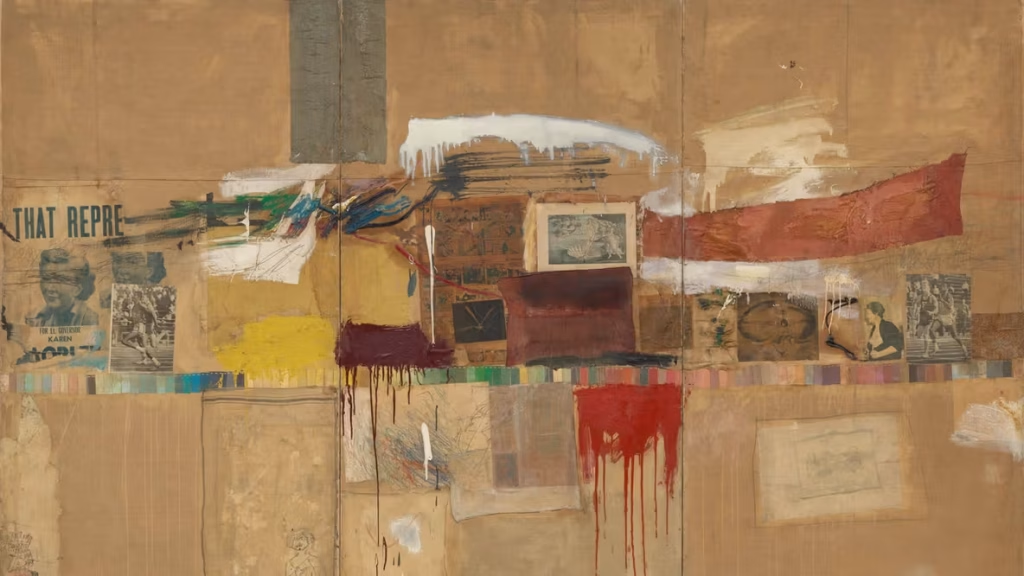
Jackson Pollock’s energy spoke to me deeply. Using “little bottles” to drop color onto the canvas, I embraced the spontaneity of the drip. Robert Rauschenberg was another key influence — his use of mixed media and found objects resonated with my soul.
1ºHe proved that art could be a mix of history and materials. Like him, I wanted to incorporate the world into my work.
The Archeology of Memory: Found Objects
Found objects are very precious to me. I discovered special papers from Japan with incredible textures. I also began collecting old letters and vintage writing. To me, these are vessels of history.
My obsession with found objects is rooted in their tactile history. I seek out Japanese Washi and Kozo papers. These papers have a “soul.” They are strong yet delicate, much like memories. Found objects create depth and dimension in my work. When I use a fragment of a letter, I invite a human connection into the piece.
Later, I began using my late husband’s stamp collection. These stamps came from many different countries. He saved the old envelopes addressed to him. That is what made them special. They held a connection to the people who wrote them. By embedding these into texture paste, I give them a permanent home. I often use gesso to create a “bed” for these objects. This process of “embedding” is what I call Dimensional Assemblage.
The Palette Knife: Creating Dimension
Because I moved away from the brush, the palette knife became my most essential tool.
It’s an artist’s best tool. It goes beyond painting. It builds rich textures and layers. Most importantly, it creates dimension.
The palette knife is an extension of my intent. Unlike a brush, the metal blade keeps the color pure. When I work on my Minimalism series, I need that clarity. I love scraping and adding layers with gesso and texture paste.
The knife allows me to perform Impasto. This is a technique where paint is applied very thickly. This creates “peaks and valleys” on the surface. When light hits these ridges, it casts tiny shadows. This is how I achieve true dimension. The painting becomes a living object. The knife also lets me “scrape back.” This helps me reveal hidden layers of gesso. It mimics the way time wears away at our memories. For years, I also worked with resin. Resin provides a glass-like depth. It traps the layers of memory beneath a clear finish.
The year 2000:
I used to think of my early years as having “pauses,” but I realize now that wasn’t true. Even when I wasn’t showing my work, art was something I always went back to. When I was feeling depressed or going through difficult times in my life, I turned to my materials. In many ways, art saved me many times. It was never about the gallery world back then; it was about survival and expression. It was my quiet place when the world felt too loud, and it gave me a way to process emotions that words couldn’t reach.
I officially leaned into my professional path in 2000. I am so grateful that creativity always stayed by my side, waiting for me to be ready again. Having my first art show that year was a moment of true creative reclamation.
Finding My Voice: The Pouring Process
However, finding my true voice took more time. About eight years ago, I found my new series: Minimalism. Along with it, I discovered what is now my favorite technique: my fluid pouring process. I love this process because it is unpredictable at times. The paint often has a mind of its own, which I find very refreshing.
The pour is all about the balance of water and paint. It requires you to let go of control, but at the same time, you need to maintain some control as well. It is a constant balancing act of courage and taking risks. When I move the canvas to let the colors flow and merge, I am making a choice to trust the medium. This way of working reminds me of the “splattering” I did as a young artist, but it carries more wisdom now. For me, Minimalism is not about doing less; it is about choosing the most important risks and letting them shine on the canvas.
The Circle of Mentorship
Today, my view on mentorship has changed. I once wished for someone to push me forward. Now, I love being a mentor to other artists. I want to provide the encouragement I once lacked.
I am also grateful that I still have a mentor at times. We all need support to move forward. The role of artist friends is also very important. When a “pour” goes wrong, these are the people I call. We discuss the “chemistry” of the materials. We talk about how resin reacts to different pigments. This technical talk is just as important as emotional support.
We push each other to experiment. We might try a new grade of sandpaper or a new type of medium. This community turns a solitary act into a shared journey. It ensures that none of us ever has to feel “not ready” again.
I have come a long way from that young girl in Hollywood Hills.
Today, I no longer listen to the critics.
I follow my own path.
My work shows that it is never too late to frame your history.
It is never too late to find your voice and create your own dimension.


