
The Power of Scale:
In the silent moments of a luxury hotel lobby, before a guest ever speaks to a concierge or touches a room key, a conversation is already happening. It is a visual dialogue between the guest and the space. As hospitality art consultants and interior designers, we are the architects of that dialogue.
Today’s luxury traveler isn’t just looking for a place to sleep; they are looking for a feeling. They are seeking an experience that transcends the four walls of a suite. And nothing creates that experience more profoundly than a large-scale statement piece.
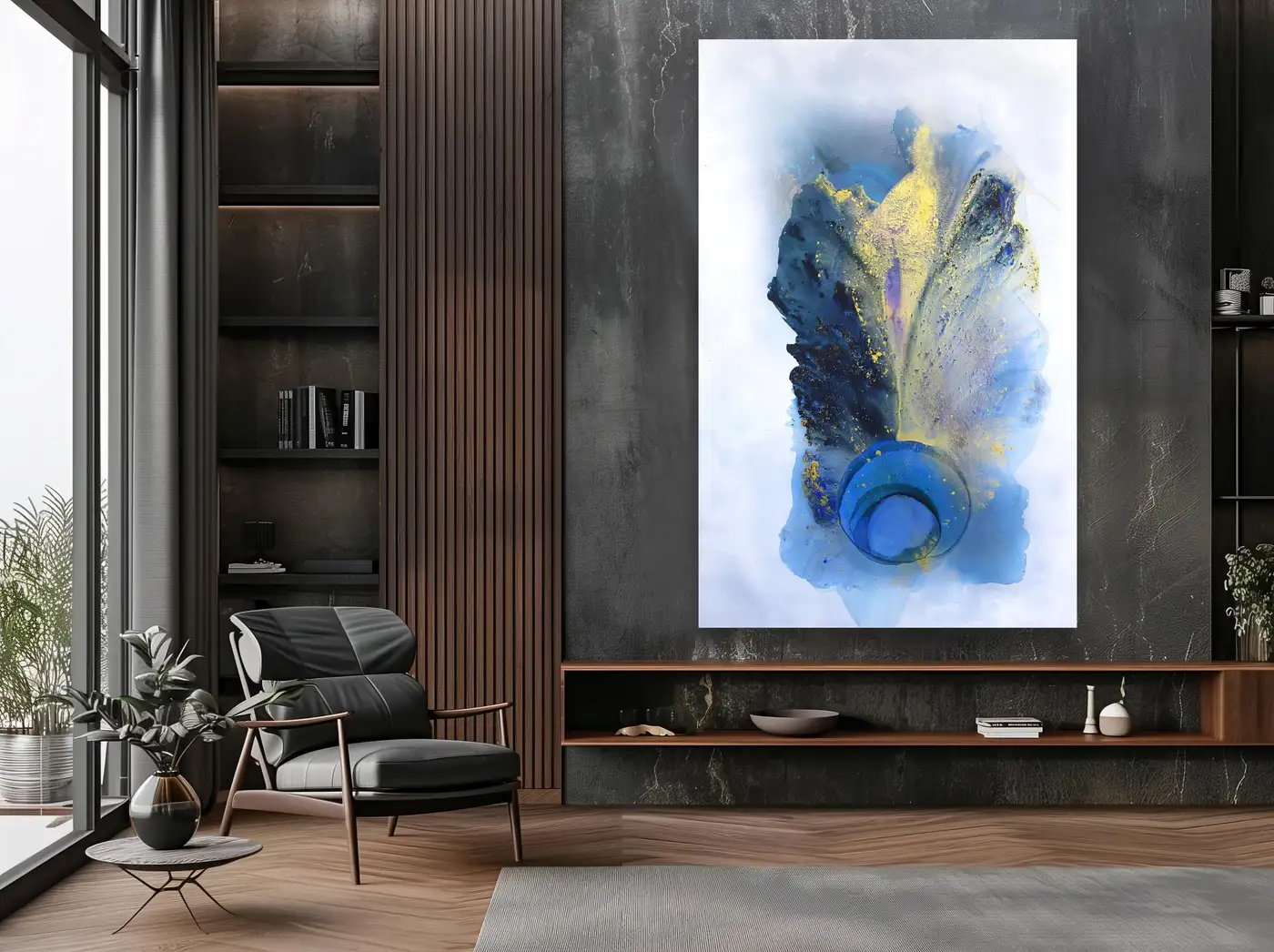
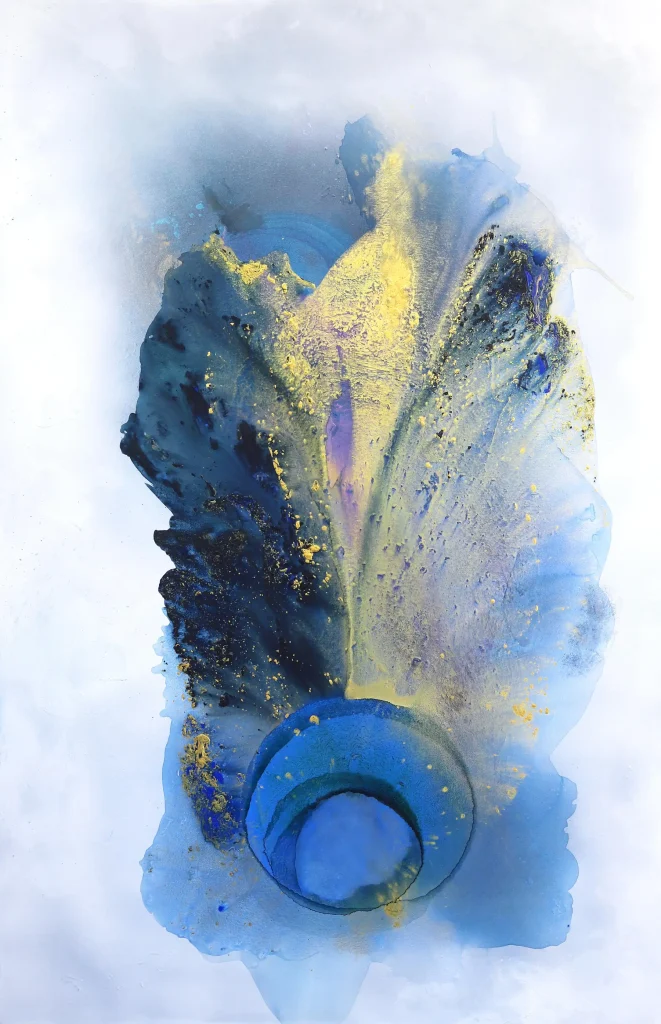
One of the most powerful examples of this “emotional architecture” is “Harmony” (2024). Currently featured through Artspace Warehouse, this 93 x 60-inch masterpiece is a testament to why scale, movement, and emotion are the three pillars of high-end hospitality design.
The Invisible Foundation: The Art of the Airbrush
When I begin a work of this magnitude, the first layer is the most silent, yet the most vital. I use an airbrush to create the background—a technique that requires a meditative level of control.
In my studio, this process is about achieving a surface that is clean and precise. There is a specific kind of beauty in a gradient that has no visible beginning or end; it mimics the sky at dusk or the deep floor of the ocean. To achieve this at a scale of nearly eight feet tall, I collaborate closely with my assistant. He is a master of his craft, and our partnership is a study in balance. While I direct the vision and the emotional “temperature” of the piece, we work in a synchronized dance to ensure the technical execution of the airbrush is flawless.
This level of precision is exactly what a hospitality art consultant looks for. In a five-star setting, “luxury” is synonymous with “perfection.” If the foundation of the art isn’t clean, the statement won’t land. By mastering this tool, I create a sense of infinite depth that pulls the guest in before they even realize they are looking at a painting.

The Archaeology of the Canvas: Layering the Story
Once the airbrushed foundation is set, I begin the process of layering. I view each layer as a “memory.” In Harmony, you can see the history of the work through its transparency.
-
The Subconscious Layers: These are the fluid, watery acrylics that establish the piece’s emotional temperature.
-
The Structural Layers: These are the “movements.” This is where I use my whole body to swing paint across the 60-inch width. At this scale, the movement isn’t just in the wrist; it’s in the shoulders and the breath.
-
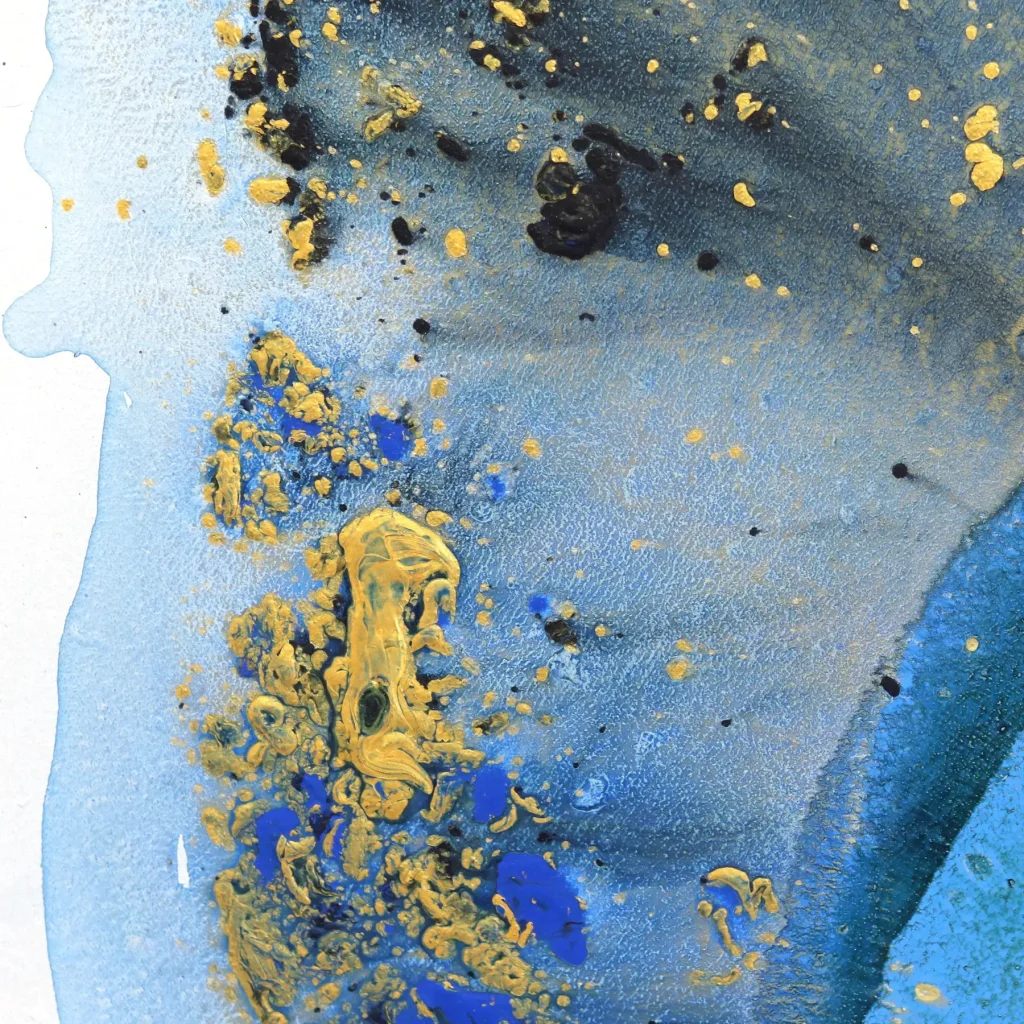
The Final Touch: The inclusion of gold. Gold isn’t just a color; it’s a frequency. It reflects the room’s lighting to the viewer, creating a visual hook that changes as the guest walks past.
The Psychology of the Circle: Coming Full Circle
The most profound moment in creating Harmony was the addition of the circular motion at the very end.
What does a circle represent? To me, it is the ultimate symbol of the human experience. We are constantly creating a life that brings us memories as we come full circle.
In hospitality, the circle represents the return guest—the person who comes back to a hotel because of how it made them feel. A circle has no corners; it is inclusive, protective, and whole. When a guest stands before a 93-inch canvas and sees that sweeping motion, it resonates with their own internal rhythm. It provides a sense of closure and peace in a world that often feels linear and exhausting.
The Synergy of the Studio: A Master-Apprentice Collaboration
While the vision for Harmony is mine, the physical realization of a 93-inch canvas is a feat of teamwork. In my studio, the relationship with my lead assistant is built on a shared language of precision. Large-scale hospitality art requires an impeccable finish; there is nowhere for a mistake to hide.
We approach the airbrushing stage like a choreographed dance. My assistant’s role is critical—he ensures consistent paint flow while I guide the atmospheric gradient. This collaboration mirrors the hospitality industry itself. A guest’s experience is never the result of just one person; it is the synergy of the architect, the designer, the consultant, and the artist. By working with a dedicated team, I ensure that every commission is delivered with “white-glove” technical quality, from the first airbrushed mist to the final protective varnish.
The Neuroaesthetics of Blue and Gold
In hospitality, color is more than an aesthetic choice—it is a psychological tool. Harmony leans heavily into a palette of deep cerulean, ethereal whites, and radiant gold. Why? These colors are scientifically proven to trigger a “rest and digest” response in the human brain.
Blue is universally associated with the vastness of the sea and sky, which helps lower blood pressure and slow heart rate. In the busy, often hectic environment of a hotel lobby, this color serves as a non-verbal cue for the guest to relax. The gold accents then provide the “warmth” of sunlight, creating a balanced sensory experience. When a consultant places this work, they aren’t just “decorating” a room; they are performing a form of environmental psychology that improves the guest’s biological well-being.
Case Study: The Cosmopolitan Hotel and the Power of Texture
I am reminded of a project I completed for an interior designer and art consultant for the Cosmopolitan Hotel. This wasn’t just about placing a painting; it was about creating a physical presence that could compete with the high-energy, high-glamour environment of Las Vegas.

For the Cosmopolitan project (which you can view in my Interiors Gallery), the work had to be highly textured. In a massive penthouse, a flat image is easily forgotten. But texture invites the guest to engage.
I built up the surface using heavy-body acrylics and mixed media, creating a topography that changed as the sun moved across the sky. It was thick, visceral, and alive. Texture is the language of luxury—it signals that the work is handmade and one-of-a-kind. It is the antithesis of the digital world.
Educating the Consultant: What is the “Experience Economy”?
To understand what moves the client, we must understand the Experience Economy. In this framework, the “experience” is the product.
For a hotel, the room is a “good,” but the feeling of walking through the lobby is the “experience.” As a hospitality art consultant, your job is to be an “Experience Architect.” When you argue for a large-scale original over a series of small prints, you are arguing for the emotional ROI (Return on Investment).
Why Art Consultants Desire Statement Art:
-
The “Awe” Factor: Large-scale visual stimuli trigger the “vagus nerve,” which lowers heart rates and creates an instant sense of well-being.
-
The “Instagrammable” Moment: In the digital age, a massive, vibrant canvas serves as a primary backdrop for guest photos, providing organic marketing for the property.
-
The Anchor: Large works act as visual anchors in cavernous lobbies, preventing furniture and architecture from feeling “lost.”
Researching the Experience: What Moves the Modern Traveler?
What moves the client? They are seeking transformation.
-
Belonging: Research shows that art in hotels reduces the “isolation” of travel. A large, emotive painting feels like a soul in the room.
-
Transcendence: Standing in front of Harmony, the colors wrap around your peripheral vision. You aren’t just looking at the art; you are inside it.
-
Authenticity: Seeing the texture of the paint and the precision of the airbrushing makes a guest feel they are in a space that was crafted specifically for them.
Elevated Interiors: The Grandeur of Harmony
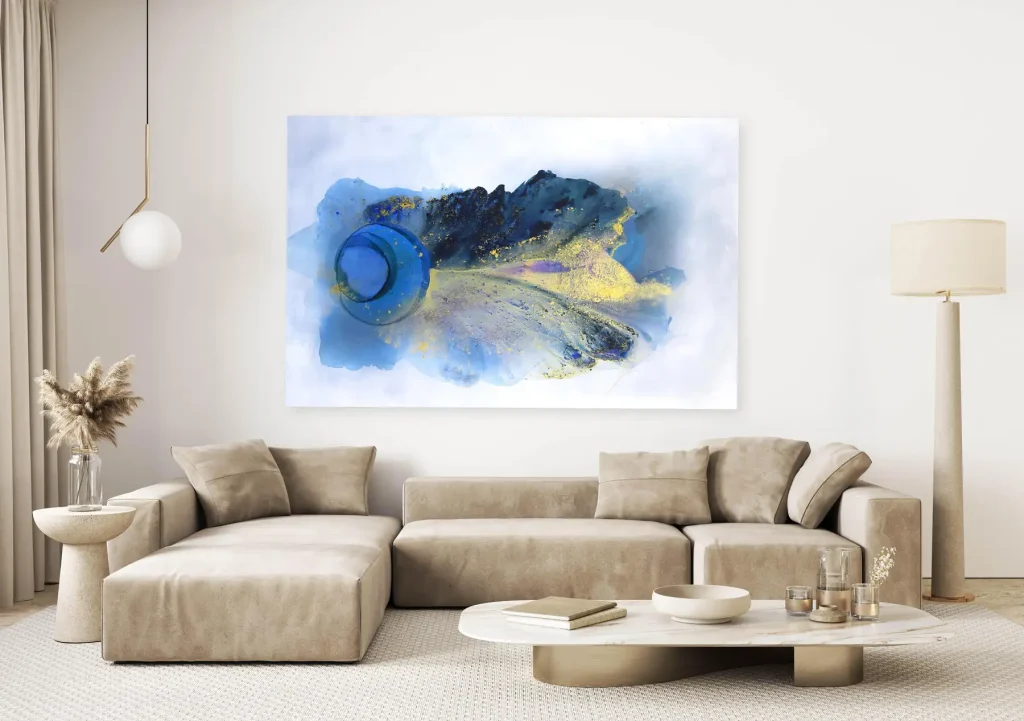
Imagine walking into a luxury penthouse. The floor-to-ceiling windows overlook a twilight skyline. The furniture is sleek—velvet textures and brass accents. But the room feels cold until you turn the corner.
There, bathed in soft gallery lighting, is Harmony.
The blues in the painting catch the light of the city outside. The sheer scale of the 93-inch canvas balances the height of the ceilings. Suddenly, the room has a heartbeat. The “movement” in the brushstrokes mirrors the energy of the city, yet the “harmony” of the composition brings a Zen-like stillness. This is the “Statement” I strive to create.
Conclusion: Designing for the Soul
As we look toward the future of hospitality design, the trend is clear: Art is no longer an afterthought. It is the starting point.
Making a statement is key. In a world that often feels fragmented, my work seeks to bring us back to a center. Through the layers, the precision of the airbrush, the shimmer of gold, and the final, sweeping motion of the circle, I am creating a visual home for the modern traveler.
If you are a hospitality art consultant looking for works that don’t just fill walls but define experiences, I invite you to reach out. Let’s create a “Full Circle” moment for your next project.


